
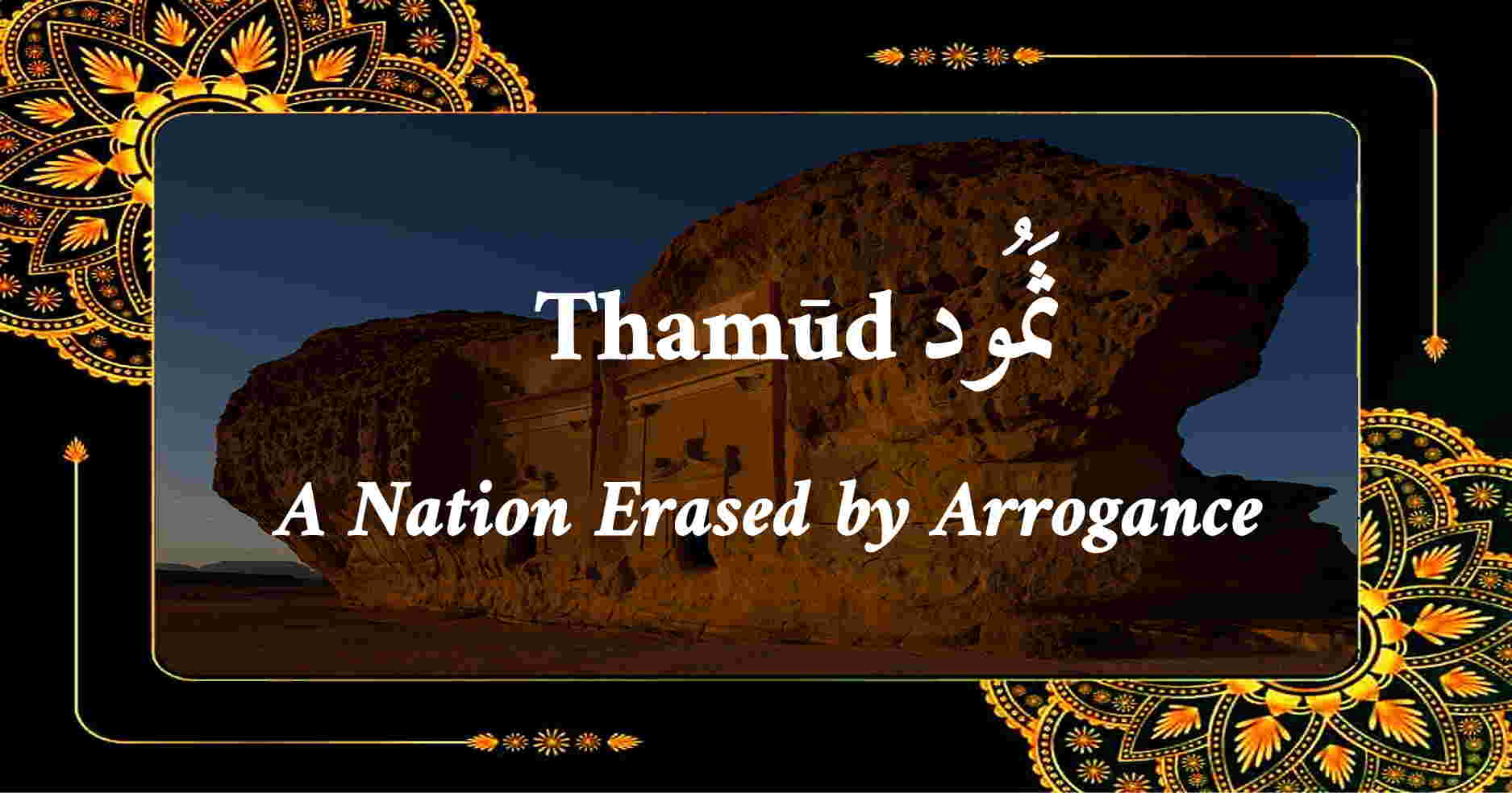
Who were Thamūd?
The destroyed nation repeatedly mentioned in the Qur’an
Thamūd (ثَمُودُ) were an ancient Arab people known for their remarkable strength, engineering skill, and mountain-carved homes. They were sent the Prophet Ṣāliḥ (صَالِحٌ), but rejected his call to worship Allah alone and defied a clear miracle — the she-camel of Allah (نَاقَةَ ٱللَّهِ). Their story is narrated in multiple surahs, making them one of the most frequently mentioned destroyed nations in the Qur’an.
Who were Thamūd?
Thamūd (Thamūd — ثَمُودُ) were a powerful tribe who lived after the people of ‘Ād. According to the Qur’an, Allah settled them in a fertile valley, gave them strength, and allowed them to carve secure homes into mountains — a sign of their advanced ability and prosperity:
وَثَمُودَ الَّذِينَ جَابُوا الصَّخْرَ بِالْوَادِ (89:9)
“And Thamūd, who carved out rocks in the valley.” (89:9)
They lived in the region known today as Al-Ḥijr / Madā’in Ṣāliḥ (northwest Arabia), an archaeological site recognized by UNESCO. Classical scholars such as Ibn Kathīr describe them as Arabs, descendants of Thamūd bin ‘Āthir bin Iram.
Where Thamūd Are Mentioned in the Qur’an
The story of Thamūd is not limited to a single surah. Their rejection of Prophet Ṣāliḥ (peace be upon him), the miracle of the she-camel, and their destruction are spread across multiple chapters. The Qur’an presents their account in different contexts: warnings, history, moral lessons, and reminders of Allah’s justice.
| Surah | Ayah Range | Theme |
|---|---|---|
| Al-A‘rāf (7) | 73–79 | Full dialogue with Prophet Ṣāliḥ, miracle mentioned |
| Hūd (11) | 61–68 | Command to worship Allah, killing of the camel, destruction |
| Ash-Shu‘arā’ (26) | 141–159 | Proofs rejected, punishment descends |
| Al-Qamar (54) | 23–31 | Their arrogance and the “most wicked man” |
| Ash-Shams (91) | 11–15 | Brief summary: sin, crime, destruction, lesson |
Prophet Ṣāliḥ and His Message
Allah sent to them Ṣāliḥ (صَالِحٌ), a prophet from among their own people. He reminded them of Allah’s blessings and called them to abandon idol worship and return to pure tawḥīd:
يَا قَوْمِ اعْبُدُوا اللَّهَ مَا لَكُم مِّنْ إِلَٰهٍ غَيْرُهُ (7:73)
“O my people, worship Allah; you have no deity other than Him.” (7:73)
He reminded them that Allah gave them strength, fertile land, and the ability to cut homes into mountains — yet they chose arrogance, corruption, and disbelief.
The Miracle of the She-Camel
As a proof of his truthfulness, Prophet Ṣāliḥ asked Allah to send them a sign. In response, Allah brought forth a she-camel (Naqat Allāh — نَاقَةَ ٱللَّهِ) from solid rock — a living miracle they could see with their own eyes.
هَٰذِهِ نَاقَةُ اللَّهِ لَكُمْ آيَةً (7:73)
“This is the she-camel of Allah, a sign for you.” (7:73)
They were commanded:
- Do not harm her
- Let her graze freely
- She drinks from the well one day, you drink the next
But arrogance overcame them — they plotted against the miracle and killed her, led by “the most wicked one among them”:
إِذِ ٱنۢبَعَثَ أَشْقَىٰهَا (91:12)
“When the most wicked among them rose up.” (91:12)
A full article about the miracle of the she-camel will follow soon:
The Miracle of Naqat Allāh (coming soon)
Their Crime and Their Punishment
After killing the she-camel, they were given a final warning — three days to repent — but they refused. Then Allah sent against them the Blast (الصَّيْحَةُ), a terrible scream from the sky, destroying all of them.
فَأَخَذَتْهُمُ ٱلصَّيْحَةُ فَأَصْبَحُوا فِي دِيَارِهِمْ جَاثِمِينَ (11:67)
“So the Blast seized them, and they lay lifeless in their homes.” (11:67)
The Qur’an repeats this pattern many times: blessings → warning → miracle → arrogance → destruction.
What the Prophet ﷺ Said About Thamūd
The Messenger of Allah ﷺ warned the Ummah not to repeat the sins of past nations. When he and the Companions passed by the ruins of Thamūd during the Tabūk expedition, he gave several instructions recorded in Sahih al-Bukhari and Sahih Muslim.
“Do not enter upon the dwellings of those who wronged themselves, unless you are weeping, lest what befell them befall you.”
— Sahih al-Bukhari (No. 3380), Sahih Muslim (No. 2980)
The Companions had taken water from the wells of Thamūd. The Prophet ﷺ ordered them to pour it out and not to drink or use it for dough, except from the well from which the she-camel used to drink.
— Sahih Muslim (No. 2981)
These narrations make two key lessons clear:
- The ruins of destroyed nations are not tourist attractions, but warnings.
- Allah’s punishment is real, and history repeats itself when people repeat the same sins.
Archaeology and the Site of Madā’in Ṣāliḥ
The region commonly linked to Thamūd today is Al-Ḥijr / Madā’in Ṣāliḥ (near Al-‘Ulā, northwestern Saudi Arabia). It contains magnificent stone-cut chambers and tombs, similar to Petra in Jordan, and is now a UNESCO World Heritage site.
However: the purpose of visiting such places in Islam is not sightseeing — it is reflection and fear of Allah’s punishment, exactly as the Prophet ﷺ instructed.
The Qur’an itself speaks of these remains as “signs for people who reflect.”
Important Vocabulary in the Story
| Word | Literal Meaning | Contextual Meaning |
|---|---|---|
| نَاقَةَ ٱللَّهِ | The she-camel of Allah | A miracle sent by Allah, not owned by anyone |
| عَقَرُوهَا | They hamstrung / killed her | Act of open rebellion against Allah’s sign |
| ٱلطَّاغِيَةُ | The transgressor / tyrant act | Refers to the wicked one who led the killing |
| ٱلصَّيْحَةُ | The scream / blast | Punishment sent from the sky that killed them all |
Lessons from the Story of Thamūd
- Miracles do not benefit those who refuse guidance. They saw a living sign yet rejected it.
- Prosperity is not a sign of Allah’s pleasure. They were advanced, but spiritually ruined.
- Arrogance toward prophets always leads to destruction.
- One sin — if done in defiance of Allah — can destroy an entire nation.
- The ruins of destroyed nations are reminders, not heritage sites.
The Qur’an summarizes their end in one powerful ayah:
فَدَمْدَمَ عَلَيْهِمْ رَبُّهُم بِذَنبِهِمْ فَسَوَّاهَا (91:14)
“So their Lord crushed them for their sin and made it equal upon all of them.” (91:14)
<---
Related Articles (coming soon)
- The Miracle of the She-Camel (Naqat Allāh)
- Why Nations Were Destroyed in the Qur’an
- Deep Tafsir of Surah Ash-Shams
–/>