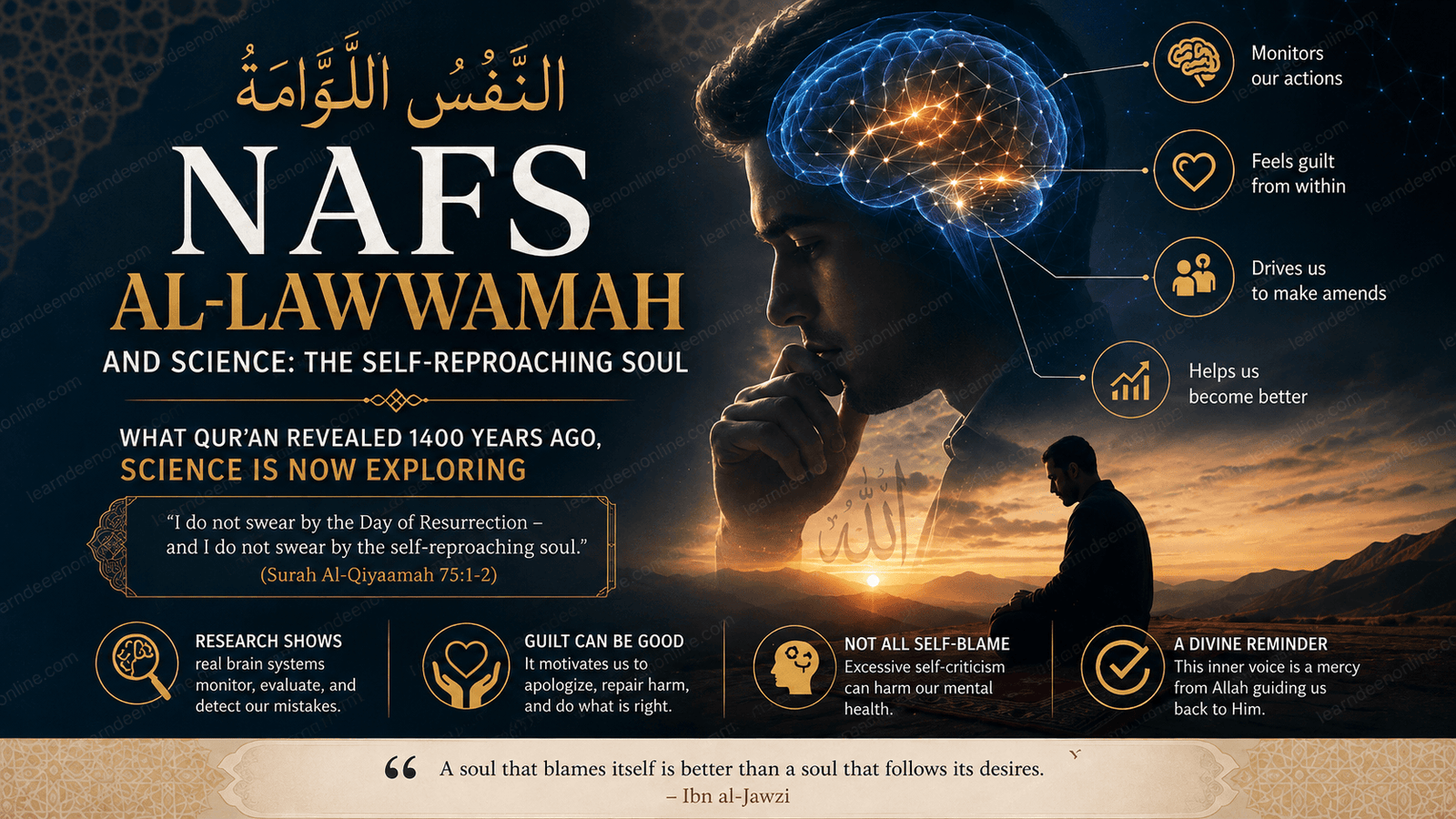
Nafs al-Lawwamah and Science: The Self-Reproaching Soul

What happens inside us when we recognise that we have done something wrong—even when nobody else knows? The Qur’an gives a striking name to the self that turns back upon itself in blame: al-nafs al-lawwāmah, the self-reproaching soul.

Modern researchers now study measurable processes that sound surprisingly close to one part of this experience: self-monitoring, error detection, moral guilt, responsibility, and the urge to repair harm. A major 2025 study involving 7,978 people across 20 countries found that guilt reliably encouraged more prosocial choices. Brain-imaging research has also identified networks involved in recognising mistakes, evaluating responsibility, and responding to self-blame.

So, has science “proved” al-nafs al-lawwāmah? No—and that distinction matters. Science can investigate behaviour, emotion, cognition, and neural activity. It cannot place the Qur’anic nafs in a scanner or reduce the soul to a brain region. What it can show is that observable aspects of self-reproach are real, measurable, and deeply rooted in human behaviour.

Important distinction: This article compares the Qur’anic description with modern findings. It does not claim that neuroscience has proved the unseen reality of the soul, nor does it use science to redefine the verse.

The Qur’anic verse: النَّفْسِ اللَّوَّامَةِ

وَلَا أُقْسِمُ بِالنَّفْسِ اللَّوَّامَةِ

“And I swear by the self-reproaching soul.” — Qur’an 75:2

The verse appears at the beginning of Surah Al-Qiyamah, immediately after the oath by the Day of Resurrection. The surah then speaks of resurrection, accountability, the human being’s awareness of himself, death, and the final return to Allah.

What does Nafs al-Lawwamah mean?

Nafs al-lawwāmah is often translated as “the self-reproaching soul,” “the reproaching self,” or “the self that blames itself.” The English word conscience captures part of the idea, but it is not a complete equivalent.

In his explanation of Qur’an 75:2, Tafsīr al-Saʿdī states that this description includes both righteous and wicked souls. It is called lawwāmah because of its frequent fluctuation and self-reproach, and because it does not remain fixed in one condition. At death, the soul blames its owner for what was done; the believer’s soul also reproaches him during worldly life for neglect, failing to fulfil a right, or heedlessness.

This explanation is broader than a momentary feeling of guilt. It includes:

  • awareness of one’s own conduct;
  • recognition of neglect or wrongdoing;
  • inner blame and regret;
  • moral accountability before death and after it.

The Qur’anic concept therefore belongs to a theological and moral framework. It concerns the human self before Allah—not merely an emotion produced by the nervous system.

What modern science actually studies

Researchers do not use the category nafs al-lawwāmah in mainstream neuroscience. Instead, they investigate narrower, observable processes that overlap with aspects of self-reproach.

1. The mind can monitor and detect its own errors

Psychologists use the term metacognition for our ability to assess our own thinking and performance. It includes recognising whether we are likely to be right or wrong, noticing errors, and adjusting future behaviour.

In a 2024 fMRI study, 50 university students evaluated biological models while researchers measured brain activity. Students whose self-assessments more accurately matched their actual performance showed greater recruitment of lateral prefrontal regions associated with monitoring and controlled reasoning.

This study was about academic error detection, not sin or moral guilt. It should not be presented as direct evidence for the Qur’anic soul. Its relevance is narrower: human beings possess measurable processes through which they evaluate their own performance and detect when something is wrong.

2. Guilt can guide behaviour even across very different cultures

One of the most relevant recent findings was published in Nature Human Behaviour in 2025. Researchers conducted a preregistered experiment involving 7,978 participants across 20 culturally diverse countries.

The study distinguished two possible social emotions:

  • Guilt was manipulated by changing how much participants knew about the consequences of their decisions for another person.
  • Shame or reputational concern was manipulated by changing whether their decision could be observed.

The researchers found robust evidence that guilt promoted prosocial behaviour across the countries studied. In other words, awareness that one’s choice could harm someone influenced behaviour even beyond the question of being watched.

The study also found wilful ignorance: people sometimes avoided learning the consequences of their decisions. That nuance is important. The human self does not always welcome moral knowledge; it may respond to guilt, but it may also try to escape the information that would produce guilt.

3. Guilt can motivate compensation and repair

A 2025 neurocomputational study published by eLife examined how perceived harm and personal responsibility contribute to guilt and shame, and how these emotions influence compensatory behaviour.

The findings indicated that harm and responsibility shaped guilt and shame in different ways, and that both could affect compensation. However, guilt had a greater effect than shame on the decision to compensate for harm.

This is one reason researchers often distinguish healthy guilt from global self-condemnation. Healthy guilt can remain focused on a particular action: I did something wrong; I should repair it. That action-focused response may encourage confession, apology, restitution, or changed behaviour.

4. Self-blame is real—but it can become unhealthy

Not all self-reproach leads to reform. A 2024 brain-network study involving 78 healthy adults examined functional and structural connections associated with self-blaming tendencies and anxiety. It found that self-blame and trait anxiety were associated with differences within a distributed network involved in social meaning, emotion, self-reference, morality, and conflict monitoring.

The authors emphasised that excessive or maladaptive guilt is associated with anxiety and depressive disorders. This provides an essential caution: a functioning moral response is not the same as relentless self-hatred.

Healthy self-reproach is not the same as destructive shame

A useful distinction can be expressed simply:

  • Constructive self-reproach: “I neglected a duty or harmed someone. I must turn back, repair what I can, and change.”
  • Destructive self-condemnation: “I am worthless, unforgivable, and incapable of change.”

The first response identifies a specific wrong and leaves the door open to responsibility and reform. The second attacks the entire person and can trap someone in rumination, despair, or avoidance.

Tafsīr al-Saʿdī’s wording is significant here: the believer reproaches himself for neglect, a shortcoming concerning a right, or heedlessness. The focus is on what occurred and what was left undone—not on declaring the human being beyond mercy or improvement.

Did science prove Nafs al-Lawwamah?

Science has not proved the Qur’anic soul as a metaphysical reality. It has demonstrated that several observable processes associated with self-reproach exist:

  • people monitor their own performance;
  • they detect errors and conflicts;
  • awareness of harm can produce guilt;
  • guilt can motivate prosocial and compensatory behaviour;
  • excessive self-blame can become psychologically harmful.

These findings are compatible with an observable dimension of self-reproach. They do not establish that a pattern of neural activity is the nafs, that the Qur’an is speaking only about guilt, or that psychology has captured the full meaning of the verse.

The Qur’an and laboratory science also ask different kinds of questions. Science asks: What behaviours occur? What mental processes predict them? Which neural systems participate? The Qur’an addresses: What is the human being? Why is he accountable? What does the self do before Allah? What follows death?

Confusing these levels weakens both the science and the tafsīr.

Why the comparison is still meaningful

The comparison remains valuable when it is made carefully. Modern research shows that self-evaluation is not merely a poetic idea. Humans genuinely monitor themselves, experience internally generated moral discomfort, and may change their conduct because of it—even when public observation is not the central factor.

Yet the Qur’anic description is more comprehensive. Al-nafs al-lawwāmah is placed beside the Day of Resurrection and final accountability. Its self-reproach in this life anticipates a greater reckoning to come.

The most responsible conclusion is therefore neither “science proved the verse” nor “the two have nothing to do with each other.” It is this:

Modern research has identified measurable processes of self-monitoring, moral guilt, responsibility, and corrective behaviour that resemble one observable aspect of self-reproach. These findings do not scientifically prove or define the Qur’anic reality of the soul.

From inner blame to meaningful change

The value of self-reproach is not in feeling pain for its own sake. Its value lies in what follows: honesty, repentance, restoring rights, seeking forgiveness, and correcting behaviour.

A practical response to a troubled conscience may include asking:

  • What exactly did I do—or fail to do?
  • Was a right of Allah or a right of another person neglected?
  • What can I repair now?
  • What change would prevent the same wrong from being repeated?

This turns vague self-attack into specific accountability. It also prevents a person from mistaking endless rumination for repentance.

Frequently asked questions

Where is Nafs al-Lawwamah mentioned in the Qur’an?

It is named in Surah Al-Qiyamah, verse 2: وَلَا أُقْسِمُ بِالنَّفْسِ اللَّوَّامَةِ. Allah swears by the self-reproaching soul after swearing by the Day of Resurrection.

Is Nafs al-Lawwamah the same as the conscience?

“Conscience” is a useful shorthand, but it is incomplete. According to Tafsīr al-Saʿdī, the term includes the soul’s fluctuation, repeated self-blame, regret over deeds, and reproach for neglect, shortcomings, or heedlessness.

Has neuroscience found the soul?

No. Neuroscience measures brain activity and its relationship to reported experience and behaviour. It cannot establish that a neural network is the soul or measure the unseen reality meant by nafs.

Does guilt always make people better?

No. Guilt may motivate repair and prosocial behaviour, but people can also avoid information that would make them feel responsible. Excessive self-blame may also become maladaptive and contribute to anxiety or depression.

What is the most accurate conclusion?

Research supports the existence of measurable self-monitoring, guilt, responsibility, and corrective behaviour. These resemble part of what humans experience as self-reproach, but they neither prove nor exhaust the Qur’anic meaning of al-nafs al-lawwāmah.

Continue learning:

Study Surah Al-Qiyamah word by word, with recitation, meanings, concise Tafsīr al-Saʿdī, and a short quiz.

Related themes: purification of the soul in Surah Ash-Shams and the tranquil soul in Surah Al-Fajr.

Sources and further reading

  1. Tafsīr al-Saʿdī on Surah Al-Qiyamah 75:2.
  2. Molho C, Soraperra I, Schulz JF, et al. “Guilt drives prosociality across 20 countries.” Nature Human Behaviour. 2025;9:2199–2211.
  3. Zhu R, et al. “Human neurocomputational mechanisms of guilt-driven and shame-driven compensatory behavior.” eLife. 2025.
  4. Zareba MR, et al. “Graph analysis of guilt processing network highlights links between self-blame and anxiety.” Social Cognitive and Affective Neuroscience. 2024;19(1):nsae092.
  5. Behrendt MG, et al. “Relation of life sciences students’ metacognitive monitoring to neural activity during biology error detection.” npj Science of Learning. 2024;9:16.

Scientific literature reviewed August 2026. This educational article is not a medical diagnosis or a substitute for professional mental-health care.
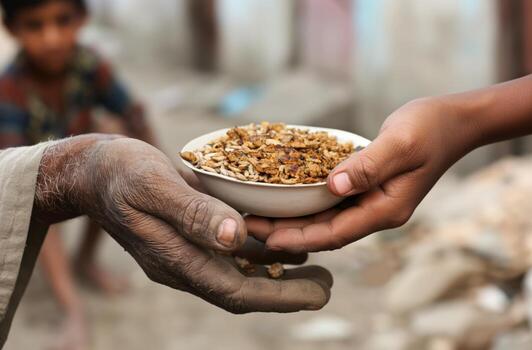
Degrees of Hunger in the Qur’an: Linguistic Precision and Meaning

Degrees of Hunger in the Qur’an: Linguistic Precision and Meaning

Degrees of Hunger in the Qur’an: Linguistic Precision and Meaning

The Qur’an does not use words randomly. Each term is selected with remarkable precision
to reflect exact physical, psychological, and social meanings. This precision becomes
especially clear in the Qur’anic vocabulary used to describe hunger,
where different words reflect different degrees, contexts, and impacts.

(جوع / Jū‘) 1) Hunger

﴿ الَّذِي أَطْعَمَهُم مِّن جُوعٍ وَآمَنَهُم مِّنْ خَوْفٍ ﴾

“Who has fed them against hunger and made them safe from fear.” (Qur’an 106:4)

The word جوع comes from the root ج و ع,
which refers to the basic state of hunger or an empty stomach. In the Qur’an, it often
appears in contexts of divine provision and relief.

This is the most general term for hunger and does not necessarily imply extreme starvation.
It represents the baseline condition of needing food.

(مَخْمَصَة / Makhmaṣah) 2) Severe Hunger and Necessity

﴿ فَمَنِ اضْطُرَّ فِي مَخْمَصَةٍ غَيْرَ مُتَجَانِفٍ لِّإِثْمٍ ﴾

“But whoever is forced by severe hunger, without inclination to sin…” (Qur’an 5:3)

The word مخمصة comes from the root خ م ص,
meaning the shrinking or hollowing of the stomach due to hunger.

In Qur’anic usage, makhmaṣah refers to a critical level of hunger that reaches
necessity. This is not ordinary hunger, but one that places a person under extreme
pressure and hardship, enough to affect legal and ethical rulings.

(مَسْغَبَة / Masghabah) 3) A Day of Harsh Hunger

﴿ فَمَنِ اضْطُرَّ فِي مَخْمَصَةٍ غَيْرَ مُتَجَانِفٍ لِّإِثْمٍ ﴾

“Or feeding on a day of severe hunger.” (Qur’an 90:14)

The term مَسْغَبَة derives from the root
س غ ب, which denotes hunger accompanied by exhaustion, hardship,
and physical strain.

The Qur’an’s use of the phrase “a day of masghabah” indicates that hunger here
is not limited to individuals, but affects the wider community. It reflects a time of
widespread hardship, where acts of charity—especially feeding others—carry immense moral
weight.

سَغَب (Saghb) 4) Related Concept

The word سغب is closely related toمسغبة. It describes hunger combined with fatigue\and difficulty.
While saghb may refer to hardship in general, masghabah intensifies the meaning by tying it to a specific time marked by extreme deprivation.

Summary of Qur’anic Terms

Term Arabic Intensity Context Meaning
Hunger جوع General Provision Basic hunger
Severe hunger مخمصة High Necessity Critical hunger forcing hardship
Harsh hunger مسغبة Very high Social hardship Hunger with exhaustion and deprivation
Related سغب High Difficulty Hunger mixed with fatigue

Conclusion

The Qur’an’s vocabulary demonstrates that hunger is not a single, flat experience.
Through precise word choice, it distinguishes between ordinary hunger, desperate necessity,
and widespread social hardship. This linguistic depth reinforces the Qur’an’s moral message:
compassion, charity, and care for others become even more meaningful in times of severe need.

Asma Allah al-Ḥusna

The 99 Beautiful Names of Allah (Asmā’ Allāh Al-Ḥusnā)

Asmā’ Allāh Al-Ḥusnā — the Most Beautiful Names of Allah — are not merely attributes; they are keys to understanding the Creator, to deepening our connection with Him, and to living a life in harmony with divine guidance.

“And to Allah belong the best names, so invoke Him by them…”
— Surah Al-A’raf (7:180)

💡 Why Learn the Names of Allah?

  • Spiritual Elevation: Knowing Allah’s names helps purify the heart and deepen one’s faith (īmān).
  • Connection in Duʿāʾ: Invoking the appropriate name brings sincerity and power to your supplications.
  • Following the Sunnah: The Prophet ﷺ said:
    “Indeed, Allah has ninety-nine names. Whoever memorizes them will enter Paradise.”
    — Sahih al-Bukhari & Sahih Muslim

🎧 Interactive Learning with Audio

On this page, each name is represented by a card. When you tap or click a name:

  • The card flips to show its meaning.
  • The audio pronunciation is played so you can hear and learn each name properly.

Tap any Name to hear it and flip the card to see its meaning.

Asmā’ Allāh al-Ḥusnā

Tap any Name to flip the card and see a short meaning & hear it.

01
الله
ALLĀH

Meaning
The Most Merciful – whose mercy encompasses all creation.

02
ٱلرَّحْمَٰن
AR-RAḤMĀN

Meaning
The Most Merciful – whose mercy encompasses all creation.

03
ٱلرَّحِيم
AR-RAḤĪM

Meaning
The Especially Merciful – who grants continuous mercy to the believers.

04
ٱلْمَلِك
AL-MALIK

Meaning
The King – the absolute sovereign and owner of all that exists.

05
ٱلْقُدُّوس
AL-QUDDŪS

Meaning
The Most Pure – free from all imperfection and deficiency.

06
ٱلسَّلَام
AS-SALĀM

Meaning
The Source of Peace – who grants safety and well-being.

07
ٱلْمُؤْمِن
AL-MU’MIN

Meaning
The Giver of Faith and security – who grants true safety to His servants.

08
ٱلْمُهَيْمِن
The Guardian

Meaning
The One who watches over, protects, and preserves all things.

09
ٱلْعَزِيز
The Almighty

Meaning
The One who is all‑powerful, undefeatable, and uniquely mighty.

10
ٱلْجَبَّار
AL‑JABBĀR

Meaning
The Compeller, the Restorer

11
ٱلْمُتَكَبِّر
AL‑MUTAKABBIR

Meaning
The Supreme, The Majestic

12
ٱلْخَالِق
AL‑KHĀLIQ

Meaning
The Creator, the Maker of all things from nothing

13
ٱلْبَارِئ
AL‑BĀRIʾ

Meaning
The Evolver, The Originator

14
ٱلْمُصَوِّر
AL‑MUṢAWWIR

Meaning
The Fashioner, The Shaper of Beauty

15
ٱلْغَفَّار
AL‑GHAFFĀR

Meaning
The Constant Forgiver

16
ٱلْقَهَّار
AL‑QAHHĀR

Meaning
The All-Subduer, The Ever-Dominating

17
ٱلْوَهَّاب
AL‑WAHHĀB

Meaning
The Supreme Bestower, The Giver without measure

18
ٱلْرَّزَّاق
AR‑RAZZĀQ

Meaning
The Sustainer, The Provider of needs

19
ٱلْفَتَّاح
AL‑FATTĀḥ

Meaning
The Supreme Opener, The Judge who opens the gates of mercy and victory

20
ٱلْعَلِيم
AL‑ʿALĪM

Meaning
The All-Knowing, The Knower of the seen and unseen

21
ٱلْقَابِض
AL‑QĀBIḌ

Meaning
The Withholder – The One who withholds provision or life

22
ٱلْبَاسِط
AL‑BĀSIṭ

Meaning
The Expander – The One who expands provision or mercy

23
ٱلْخَافِض
AL‑KHĀFIḌ

Meaning
The Abaser – The One who lowers whom He wills

24
ٱلْرَّافِع
AR‑RĀFIʿ

Meaning
The Exalter – The One who raises whom He wills

25
ٱلْمُعِزّ
AL‑MUʿIZZ

Meaning
The Honourer – The One who gives honor and might

26
ٱلْمُذِلّ
AL‑MUDHILL

Meaning
The Humiliator – The One who humbles whom He wills

27
ٱلسَّمِيع
AS‑SAMĪʿ

Meaning
The All-Hearing

28
ٱلْبَصِير
AL‑BAṢĪR

Meaning
The All-Seeing

29
ٱلْحَكَم
AL‑ḤAKAM

Meaning
The Impartial Judge

30
ٱلْعَدْل
AL‑ʿADL

Meaning
The Utterly Just

31
ٱلْلَّطِيف
AL‑LAṭĪF

Meaning
The Subtle One, The Most Gentle

32
ٱلْخَبِير
AL‑KHABĪR

Meaning
The All‑Aware

33
ٱلْحَلِيم
AL‑ḤALĪM

Meaning
The Most Forbearing

34
ٱلْعَظِيم
AL‑ʿAẓĪM

Meaning
The Magnificent, The Supreme

35
ٱلْغَفُور
AL‑GHAFŪR

Meaning
The Great Forgiver

36
ٱلشَّكُور
AS‑SHAKŪR

Meaning
The Most Appreciative

37
ٱلْعَلِيّ
AL‑ʿALIYY

Meaning
The Most High, The Exalted

38
ٱلْكَبِير
AL‑KABĪR

Meaning
The Most Great

39
ٱلْحَفِيظ
AL‑ḤAFĪẒ

Meaning
The Guardian, The Preserver

40
ٱلْمُقيِت
AL‑MUQĪT

Meaning
The Sustainer, The Maintainer of Life

41
ٱلْحسِيب
AL‑ḤASĪB

Meaning
The Reckoner, The One who counts all

42
ٱلْجَلِيل
AL‑JALĪL

Meaning
The Most Majestic

43
ٱلْكَرِيم
AL‑KARĪM

Meaning
The Most Generous, The Most Bountiful

44
ٱلْرَّقِيب
AR‑RAQĪB

Meaning
The Watchful, The Ever Observing

45
ٱلْمُجِيب
AL‑MUJĪB

Meaning
The Responsive, The Answerer of Supplication

46
ٱلْوَاسِع
AL‑WĀSIʿ

Meaning
The All‑Encompassing, The Boundless

47
ٱلْحَكِيم
AL‑ḤAKĪM

Meaning
The All‑Wise

48
ٱلْوَدُود
AL‑WADŪD

Meaning
The Most Loving

49
ٱلْمَجِيد
AL‑MAJĪD

Meaning
The Most Glorious, The Most Honorable

50
ٱلْبَاعِث
AL‑BĀʿITH

Meaning
The Resurrector, The Restorer of Life

51
ٱلشَّهِيد
AS‑SHAHĪD

Meaning
The Witness

52
ٱلْحَقّ
AL‑ḤAQQ

Meaning
The Truth

53
ٱلْوَكِيل
AL‑WAKĪL

Meaning
The Trustee, The Disposer of Affairs

54
ٱلْقَوِيّ
AL‑QAWĪYY

Meaning
The All‑Strong

55
ٱلْمَتِين
AL‑MATĪN

Meaning
The Firm, The Steadfast

56
ٱلْوَلِيّ
AL‑WALIYY

Meaning
The Protecting Friend, The Patron

57
ٱلْحَمِيد
AL‑ḤAMĪD

Meaning
The Praiseworthy

58
ٱلْمُحْصِي
AL‑MUḤṢĪ

Meaning
The Appraiser, The Counter (of all things)

59
ٱلْمُبْدِئ
AL‑MUBDIʾ

Meaning
The Originator, The Initiator of Creation

60
ٱلْمُعِيد
AL‑MUʿĪD

Meaning
The Restorer, The Reinstater

61
ٱلْمُحْيِي
AL‑MUḤYĪ

Meaning
The Giver of Life

62
ٱلْمُمِيت
AL‑MUMĪT

Meaning
The Creator of Death, The Disposer of Souls

63
ٱلْحَيّ
AL‑ḤAYY

Meaning
The Ever‑Living, The Sustainer of Life

64
ٱلْقَيُّوم
AL‑QAYYŪM

Meaning
The Self‑Subsisting, The Sustainer of all existence

65
ٱلْوَاجِد
AL‑WĀJID

Meaning
The Finder, The Ta’allūm Seeker

66
ٱلْمَاجِد
AL‑MĀJID

Meaning
The Noble, The Generous

67
ٱلْواحِد
AL‑WĀḥID

Meaning
The One, The Unique, The Only One

68
ٱلصَّمَد
AṢ‑ṢAMAD

Meaning
The Eternal Refuge, The One whom all depend upon

69
ٱلْقَادِر
AL‑QĀDIR

Meaning
The All‑Capable, The Omnipotent

70
ٱلْمُقْتَدِر
AL‑MUQTAḌIR

Meaning
The All‑Powerful, The Dominant

71
ٱلْمُقَدِّم
AL‑MUQADDIM

Meaning
The Expediter, The One who brings forward

72
ٱلْمُؤَخِّر
AL‑MUʾAKHKHIR

Meaning
The Delayer, The One who puts far ahead

73
ٱلْأوَّل
AL‑AWWAL

Meaning
The First

74
ٱلْآخِر
AL‑ĀḤIR

Meaning
The Last

75
ٱلظَّاهِر
AẒ‑ẒĀHIR

Meaning
The Manifest, The Evident

76
ٱلْبَاطِن
AL‑BĀṭIN

Meaning
The Hidden, The Inward

77
ٱلْوَالِي
AL‑WĀLĪ

Meaning
The Sole Governor, The Friend

78
ٱلْمُتَعَالِي
AL‑MUTAʿĀLĪ

Meaning
The Most Exalted

79
ٱلْبَرّ
AL‑BARR

Meaning
The Source of All Goodness and Righteousness

80
ٱلتَّوَّاب
AT‑TAWWĀB

Meaning
The Ever‑Accepting of Repentance

81
ٱلْمُنْتَقِم
AL‑MUNTAQIM

Meaning
The Avenger, The Retaliator

82
ٱلْعَفُوّ
AL‑ʿAFŪW

Meaning
The Pardoner, The One who erases sin

83
ٱلرَّؤُوف
AR‑RAʾŪF

Meaning
The Most Kind, The Most Compassionate

84
مَالِكُ ٱلْمُلْك
MĀLIK‑ul‑MULK

Meaning
The Owner of All Sovereignty

85
ذُو ٱلْجَلَالِ وَٱلْإِكْرَام
DHŪ‑l‑JALĀL wa-l‑IKRĀM

Meaning
The Lord of Glory and Honour

86
الْمُقْسِط
AL‑MUQSIT

Meaning
The Just One

87
الْجَامِع
AL‑JĀMIʿ

Meaning
The Gatherer, The Uniter

88
الْغَنِيّ
AL‑GHANIYY

Meaning
The Self‑Sufficient, The Rich beyond need

89
الْمُغْنِي
AL‑MUGHNĪ

Meaning
The Enricher, The Bestower of Wealth

90
الْمَانِع
AL‑MĀNʿ

Meaning
The Withholder, The Preventer

91
الضَّارّ
AḌ‑ḌĀRR

Meaning
The Harmer (Only what He wills), The One who inflicts harm when He wills

92
النَّافِع
AN‑NĀFIʿ

Meaning
The Benefactor, The One who brings benefit

93
النُّور
AN‑NŪR

Meaning
The Light, The Illuminator

94
الْهَادِي
AL‑HĀDĪ

Meaning
The Guide, The One who shows the way to truth

95
الْبَدِيع
AL‑BADĪʾ

Meaning
The Originator, The Incomparable

96
الْبَاقِي
AL‑BĀQĪ

Meaning
The Everlasting, The One who remains when all else perishes

97
الْوَارِث
AL‑WĀRITH

Meaning
The Inheritor, The One who inherits all

98
الرَّشِيد
AR‑RASHĪD

Meaning
The Guide to the Right Path, The One who guides to truth

99
الْصَّبُور
AṢ‑ṢABŪR

Meaning
The Most Patient, The One who does not act in haste

ʿĀd

مَن هُم عاد؟
Who were ʿĀd?

The arrogant nation destroyed by a roaring wind

ʿĀd (عاد) were an ancient Arab people known for their physical strength, massive constructions, and pride. Allah blessed them with power and lands, yet they turned to arrogance, oppression, and idol worship. He sent to them the Prophet Hūd (هُودٌ) calling them back to worship Allah alone, but most of them rejected his message. Their story is repeated in several surahs as a warning to anyone who feels secure because of worldly power.


ʿĀd in Surah Al-Fajr

In Surah Al-Fajr, Allah mentions ʿĀd as one of the great nations that were destroyed after transgressing and spreading corruption on earth:

أَلَمْ تَرَ كَيْفَ فَعَلَ رَبُّكَ بِعَادٍ (٦)
إِرَمَ ذَاتِ الْعِمَادِ (٧)
الَّتِي لَمْ يُخْلَقْ مِثْلُهَا فِي الْبِلَادِ (٨)

“Have you not seen how your Lord dealt with ʿĀd –
  [the people of] Iram, the possessors of lofty pillars,
  the like of whom had never been created in the land?” (89:6–8)

These verses show how powerful and unique ʿĀd were in their time, yet their strength did not protect them when they disobeyed Allah and rejected His messenger.

Who were ʿĀd?

According to the Qur’an and classical scholars, ʿĀd were:

  • An ancient Arab tribe living after the time of Prophet Nūḥ (Noah) عليه السلام.
  • Settled in the region of al-Aḥqāf (الأحقاف) — sand dunes and valleys between Yemen and Oman, according to many historians of tafsīr.
  • Physically strong and advanced — they built tall structures and fortresses, and felt secure in their power.

Allah gave them strength, wealth, and long lives, but instead of being grateful, they became proud and oppressive, turning away from tawḥīd (worship of Allah alone) and following their desires and idols.

Where ʿĀd Are Mentioned in the Qur’an

The story of ʿĀd is spread across several surahs. Each passage highlights a different aspect: their arrogance, the message of Hūd, the punishment that struck them, and the lessons for later generations.

Surah Ayah Range Focus
Al-Aʿrāf (7) 65–72 Call of Hūd, rejection of the message, brief description of their destruction
Hūd (11) 50–60 Detailed dialogue between Hūd and his people, their arguments, and the end of ʿĀd
Ash-Shuʿarāʾ (26) 123–140 Repeated warnings, their mockery, and the punishment
Fuṣṣilat (41) 15–16 Their arrogance and the wind that humiliated them
Al-Qamar (54) 18–21 “How severe were My punishment and warnings!”
Al-Ḥāqqah (69) 4–8 Their end by a violent, screaming wind
Al-Fajr (89) 6–8 Mention of ʿĀd and Iram as a unique, powerful nation that was destroyed

Prophet Hūd and His Message

Allah sent to ʿĀd the Prophet Hūd (هُودٌ), one of the Arab prophets. He came from among them, spoke their language, and reminded them of Allah’s blessings:

يَا قَوْمِ اعْبُدُوا اللَّهَ مَا لَكُم مِّنْ إِلَٰهٍ غَيْرُهُ (الأعراف ٧:٦٥)

“O my people, worship Allah; you have no deity other than Him.” (7:65)

He called them to:

  • Abandon idols and false gods
  • Stop arrogance and oppression in the land
  • Be grateful for strength, livestock, gardens, and children
  • Seek Allah’s forgiveness and turn back to Him so He increases their blessings

But most of them responded with pride and mockery. They said things like: “Who is stronger than us?” and denied that a punishment could really strike them.

Their Arrogance and Their Punishment

ʿĀd became famous in the Qur’an for their arrogance. They felt secure in their constructions and strength, and they viewed Hūd and his followers as weak. When he warned them of Allah’s punishment, they challenged him instead of fearing Allah.

In the end, Allah sent against them a violent, screaming wind (رِيحًا صَرْصَرًا عَاتِيَةً) that lasted for several days, uprooting them and destroying their buildings. The Qur’an describes that nothing remained except their bodies lying on the ground, as if they were hollow trunks of palm trees.

وَأَمَّا عَادٌ فَأُهْلِكُوا بِرِيحٍ صَرْصَرٍ عَاتِيَةٍ (الحاقة ٦)

“As for ʿĀd, they were destroyed by a screaming, violent wind.” (69:6)

That wind, which they could neither see nor stop, showed them that real power belongs to Allah alone.

Important Vocabulary in the Story of ʿĀd

Word / Phrase Literal Meaning Contextual Meaning
إِرَمَ ذَاتِ الْعِمَادِ Iram, possessor of pillars The city/region of ʿĀd, known for tall pillars and strong buildings
رِيحٍ صَرْصَرٍ عَاتِيَةٍ A screaming, furious wind The destructive wind that uprooted and destroyed ʿĀd
الأحقاف Sand dunes / curved hills Region of sand dunes where ʿĀd lived
طَغْيَان / اسْتِكْبَار Transgression / arrogance Their pride and rebellion against Allah and His messenger

Lessons from the Story of ʿĀd

  • Power without faith is a test, not a guarantee. Strength, buildings, and numbers cannot protect a nation from Allah’s decree.
  • Arrogance destroys individuals and nations. Their problem was not a lack of signs, but pride and refusal to submit.
  • Prophets come from their own people. Hūd was one of them, spoke their language, cared for them — yet they still rejected him.
  • Allah’s punishment can come from where people feel strongest. They were proud of their environment and power; the wind from that same sky destroyed them.
  • The stories of destroyed nations are warnings, not just history. They are meant to soften hearts, not to entertain.

The Qur’an reminds us that the fate of ʿĀd is a sign for anyone who listens and reflects, especially when reading passages like Surah Al-Fajr and Surah Hūd.

Related Articles (coming soon)

Thamud

Thamud Nation

Who were Thamūd?

The destroyed nation repeatedly mentioned in the Qur’an

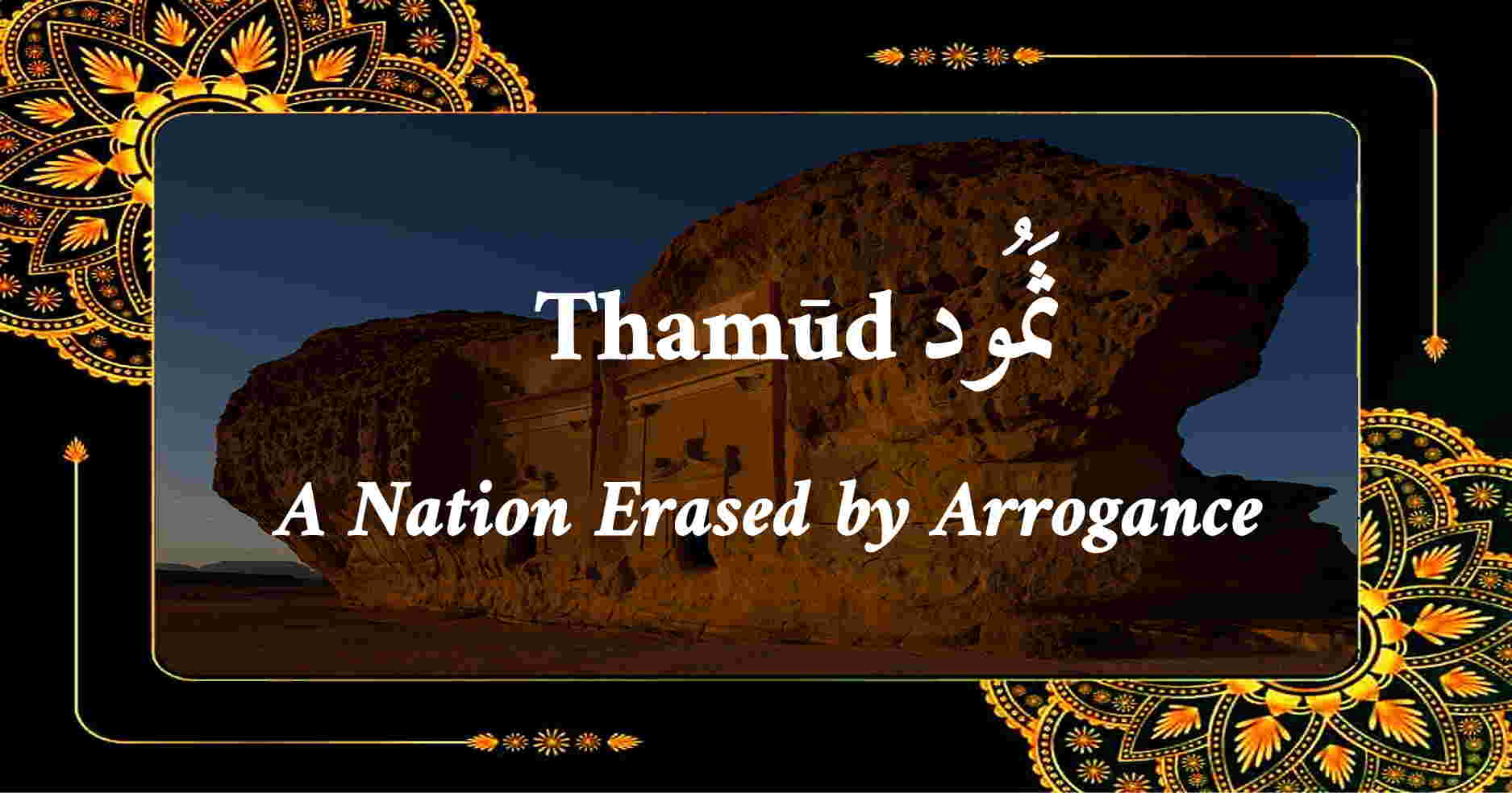
Thamūd (ثَمُودُ) were an ancient Arab people known for their remarkable strength, engineering skill, and mountain-carved homes. They were sent the Prophet Ṣāliḥ (صَالِحٌ), but rejected his call to worship Allah alone and defied a clear miracle — the she-camel of Allah (نَاقَةَ ٱللَّهِ). Their story is narrated in multiple surahs, making them one of the most frequently mentioned destroyed nations in the Qur’an.


Who were Thamūd?

Thamūd (Thamūd — ثَمُودُ) were a powerful tribe who lived after the people of ‘Ād. According to the Qur’an, Allah settled them in a fertile valley, gave them strength, and allowed them to carve secure homes into mountains — a sign of their advanced ability and prosperity:

وَثَمُودَ الَّذِينَ جَابُوا الصَّخْرَ بِالْوَادِ (89:9)

“And Thamūd, who carved out rocks in the valley.” (89:9)

They lived in the region known today as Al-Ḥijr / Madā’in Ṣāliḥ (northwest Arabia), an archaeological site recognized by UNESCO. Classical scholars such as Ibn Kathīr describe them as Arabs, descendants of Thamūd bin ‘Āthir bin Iram.

Where Thamūd Are Mentioned in the Qur’an

The story of Thamūd is not limited to a single surah. Their rejection of Prophet Ṣāliḥ (peace be upon him), the miracle of the she-camel, and their destruction are spread across multiple chapters. The Qur’an presents their account in different contexts: warnings, history, moral lessons, and reminders of Allah’s justice.

Surah Ayah Range Theme
Al-A‘rāf (7) 73–79 Full dialogue with Prophet Ṣāliḥ, miracle mentioned
Hūd (11) 61–68 Command to worship Allah, killing of the camel, destruction
Ash-Shu‘arā’ (26) 141–159 Proofs rejected, punishment descends
Al-Qamar (54) 23–31 Their arrogance and the “most wicked man”
Ash-Shams (91) 11–15 Brief summary: sin, crime, destruction, lesson

Prophet Ṣāliḥ and His Message

Allah sent to them Ṣāliḥ (صَالِحٌ), a prophet from among their own people. He reminded them of Allah’s blessings and called them to abandon idol worship and return to pure tawḥīd:

يَا قَوْمِ اعْبُدُوا اللَّهَ مَا لَكُم مِّنْ إِلَٰهٍ غَيْرُهُ (7:73)

“O my people, worship Allah; you have no deity other than Him.” (7:73)

He reminded them that Allah gave them strength, fertile land, and the ability to cut homes into mountains — yet they chose arrogance, corruption, and disbelief.

The Miracle of the She-Camel

As a proof of his truthfulness, Prophet Ṣāliḥ asked Allah to send them a sign. In response, Allah brought forth a she-camel (Naqat Allāh — نَاقَةَ ٱللَّهِ) from solid rock — a living miracle they could see with their own eyes.

هَٰذِهِ نَاقَةُ اللَّهِ لَكُمْ آيَةً (7:73)

“This is the she-camel of Allah, a sign for you.” (7:73)

They were commanded:

  • Do not harm her
  • Let her graze freely
  • She drinks from the well one day, you drink the next

But arrogance overcame them — they plotted against the miracle and killed her, led by “the most wicked one among them”:

إِذِ ٱنۢبَعَثَ أَشْقَىٰهَا (91:12)

“When the most wicked among them rose up.” (91:12)

A full article about the miracle of the she-camel will follow soon:
The Miracle of Naqat Allāh (coming soon)

Their Crime and Their Punishment

After killing the she-camel, they were given a final warning — three days to repent — but they refused. Then Allah sent against them the Blast (الصَّيْحَةُ), a terrible scream from the sky, destroying all of them.

فَأَخَذَتْهُمُ ٱلصَّيْحَةُ فَأَصْبَحُوا فِي دِيَارِهِمْ جَاثِمِينَ (11:67)

“So the Blast seized them, and they lay lifeless in their homes.” (11:67)

The Qur’an repeats this pattern many times: blessings → warning → miracle → arrogance → destruction.

What the Prophet ﷺ Said About Thamūd

The Messenger of Allah ﷺ warned the Ummah not to repeat the sins of past nations. When he and the Companions passed by the ruins of Thamūd during the Tabūk expedition, he gave several instructions recorded in Sahih al-Bukhari and Sahih Muslim.

“Do not enter upon the dwellings of those who wronged themselves, unless you are weeping, lest what befell them befall you.”
Sahih al-Bukhari (No. 3380), Sahih Muslim (No. 2980)

The Companions had taken water from the wells of Thamūd. The Prophet ﷺ ordered them to pour it out and not to drink or use it for dough, except from the well from which the she-camel used to drink.

Sahih Muslim (No. 2981)

These narrations make two key lessons clear:

  • The ruins of destroyed nations are not tourist attractions, but warnings.
  • Allah’s punishment is real, and history repeats itself when people repeat the same sins.

Archaeology and the Site of Madā’in Ṣāliḥ

The region commonly linked to Thamūd today is Al-Ḥijr / Madā’in Ṣāliḥ (near Al-‘Ulā, northwestern Saudi Arabia). It contains magnificent stone-cut chambers and tombs, similar to Petra in Jordan, and is now a UNESCO World Heritage site.

However: the purpose of visiting such places in Islam is not sightseeing — it is reflection and fear of Allah’s punishment, exactly as the Prophet ﷺ instructed.

The Qur’an itself speaks of these remains as “signs for people who reflect.”

Important Vocabulary in the Story

Word Literal Meaning Contextual Meaning
نَاقَةَ ٱللَّهِ The she-camel of Allah A miracle sent by Allah, not owned by anyone
عَقَرُوهَا They hamstrung / killed her Act of open rebellion against Allah’s sign
ٱلطَّاغِيَةُ The transgressor / tyrant act Refers to the wicked one who led the killing
ٱلصَّيْحَةُ The scream / blast Punishment sent from the sky that killed them all

Lessons from the Story of Thamūd

  • Miracles do not benefit those who refuse guidance. They saw a living sign yet rejected it.
  • Prosperity is not a sign of Allah’s pleasure. They were advanced, but spiritually ruined.
  • Arrogance toward prophets always leads to destruction.
  • One sin — if done in defiance of Allah — can destroy an entire nation.
  • The ruins of destroyed nations are reminders, not heritage sites.

The Qur’an summarizes their end in one powerful ayah:

فَدَمْدَمَ عَلَيْهِمْ رَبُّهُم بِذَنبِهِمْ فَسَوَّاهَا (91:14)

“So their Lord crushed them for their sin and made it equal upon all of them.” (91:14)

<---

Related Articles (coming soon)

–/>

Al-Raḥmān vs Al-Raḥīm: Understanding Allah’s Mercy — Universal & Specific

Al-Raḥmān vs Al-Raḥīm: Understanding Allah’s Mercy — Universal & Specific

Names of Allah
Tafsīr
Al-Fātiḥah

A concise, evidence-based explanation of how the Qur’an and classical scholars describe the relationship between the two beautiful names: Al-Raḥmān and Al-Raḥīm.

Why this distinction matters

Both names flow from the root r-ḥ-m (mercy, compassion), yet the Qur’an and the early scholars highlight a meaningful nuance:
one points to Allah’s vast, all-embracing mercy, and the other to a special, focused mercy
for those who believe and obey.

Key idea: Allah’s mercy reaches all creation continuously, and He also bestows a special mercy on the believers—guidance, forgiveness, and everlasting reward.

Linguistic snapshot

In Arabic morphology, Al-Raḥmān comes on the pattern fa‘lān—a form that conveys abundance and intensity.
Al-Raḥīm is on the pattern fa‘īl, often used for a steadfast, applied quality.
Classical exegetes used this linguistic backdrop to articulate the difference below.

Qur’anic foundation

Universal mercy

وَرَحْمَتِي وَسِعَتْ كُلَّ شَيْءٍ

“My mercy encompasses all things.” — Qur’an 7:156

Life, breath, provision, safety, opportunities—these reach every human and every creature. This is the broad, constant outpouring
often associated with Al-Raḥmān.

Specific mercy

وَكَانَ بِالْمُؤْمِنِينَ رَحِيمًا

“And ever is He, to the believers, Merciful.” — Qur’an 33:43

The Qur’an repeatedly ties a special mercy to faith and obedience—guidance, forgiveness, tranquility and, above all,
salvation in the Hereafter. This is the focused mercy commonly linked to Al-Raḥīm.

How scholars expressed the difference

  • Al-Raḥmān: points to the attribute of mercy in its vastness and universality (embracing all creation).
  • Al-Raḥīm: points to the way mercy is specifically applied to the believers—especially manifest in guidance and reward.
Mercy type Name Recipients Illustrations
Universal Al-Raḥmān All creation Existence, sustenance, daily blessings, worldly benefit
Specific Al-Raḥīm Believers Guidance, forgiveness, acceptance of deeds, Jannah
Common misunderstanding: Saying “Ar-Raḥīm is only for believers” does not mean non-believers receive no mercy. They constantly receive universal mercy (Raḥmān)—life, health, provision. The point is that the special mercy (Raḥīm) in guidance and salvation belongs to those who believe.

Practical takeaways

  • Hope & effort together: Trust Allah’s all-embracing mercy while striving to be among those who receive His special mercy.
  • Gratitude: Recognize the constant favors you live in every day—this softens the heart and feeds thankfulness.
  • Du‘ā etiquette: Begin with Bismillāh al-Raḥmān al-Raḥīm—calling on both universal and specific mercy.

References (concise)

This summary reflects mainstream explanations found in classical tafsīr and contemporary primers. For deeper reading,
consult reliable works of tafsīr under verses like 7:156 and 33:43, and discussions on the Names of Allah in
commentaries on Sūrat al-Fātiḥah.

May Allah envelop us in His universal mercy and admit us to the fullness of His special mercy in this life and the next. Āmīn.