
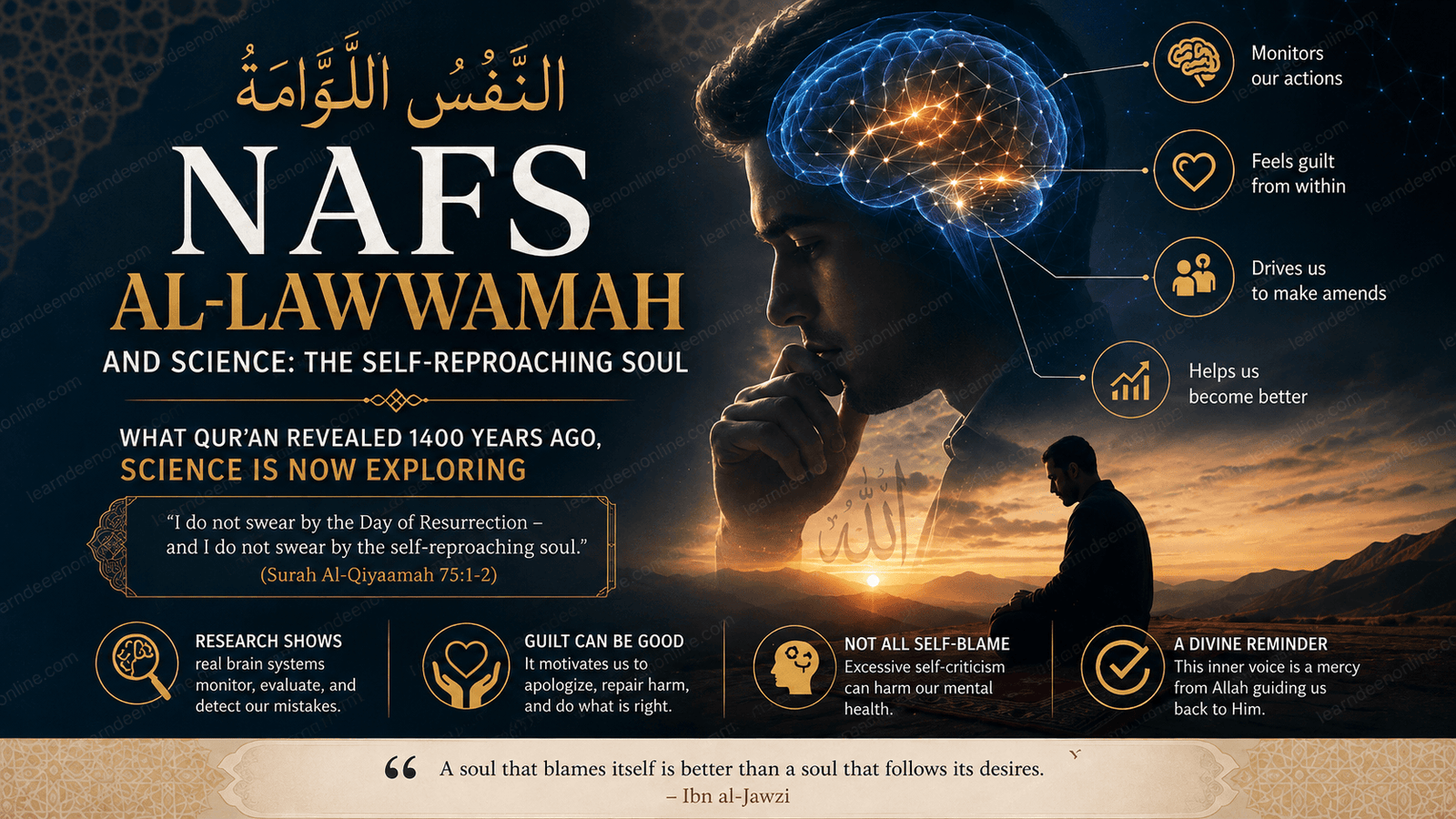
What happens inside us when we recognise that we have done something wrong—even when nobody else knows? The Qur’an gives a striking name to the self that turns back upon itself in blame: al-nafs al-lawwāmah, the self-reproaching soul.
Modern researchers now study measurable processes that sound surprisingly close to one part of this experience: self-monitoring, error detection, moral guilt, responsibility, and the urge to repair harm. A major 2025 study involving 7,978 people across 20 countries found that guilt reliably encouraged more prosocial choices. Brain-imaging research has also identified networks involved in recognising mistakes, evaluating responsibility, and responding to self-blame.
So, has science “proved” al-nafs al-lawwāmah? No—and that distinction matters. Science can investigate behaviour, emotion, cognition, and neural activity. It cannot place the Qur’anic nafs in a scanner or reduce the soul to a brain region. What it can show is that observable aspects of self-reproach are real, measurable, and deeply rooted in human behaviour.
The Qur’anic verse: النَّفْسِ اللَّوَّامَةِ
وَلَا أُقْسِمُ بِالنَّفْسِ اللَّوَّامَةِ
“And I swear by the self-reproaching soul.” — Qur’an 75:2
The verse appears at the beginning of Surah Al-Qiyamah, immediately after the oath by the Day of Resurrection. The surah then speaks of resurrection, accountability, the human being’s awareness of himself, death, and the final return to Allah.
What does Nafs al-Lawwamah mean?
Nafs al-lawwāmah is often translated as “the self-reproaching soul,” “the reproaching self,” or “the self that blames itself.” The English word conscience captures part of the idea, but it is not a complete equivalent.
In his explanation of Qur’an 75:2, Tafsīr al-Saʿdī states that this description includes both righteous and wicked souls. It is called lawwāmah because of its frequent fluctuation and self-reproach, and because it does not remain fixed in one condition. At death, the soul blames its owner for what was done; the believer’s soul also reproaches him during worldly life for neglect, failing to fulfil a right, or heedlessness.
This explanation is broader than a momentary feeling of guilt. It includes:
- awareness of one’s own conduct;
- recognition of neglect or wrongdoing;
- inner blame and regret;
- moral accountability before death and after it.
The Qur’anic concept therefore belongs to a theological and moral framework. It concerns the human self before Allah—not merely an emotion produced by the nervous system.
What modern science actually studies
Researchers do not use the category nafs al-lawwāmah in mainstream neuroscience. Instead, they investigate narrower, observable processes that overlap with aspects of self-reproach.
1. The mind can monitor and detect its own errors
Psychologists use the term metacognition for our ability to assess our own thinking and performance. It includes recognising whether we are likely to be right or wrong, noticing errors, and adjusting future behaviour.
In a 2024 fMRI study, 50 university students evaluated biological models while researchers measured brain activity. Students whose self-assessments more accurately matched their actual performance showed greater recruitment of lateral prefrontal regions associated with monitoring and controlled reasoning.
This study was about academic error detection, not sin or moral guilt. It should not be presented as direct evidence for the Qur’anic soul. Its relevance is narrower: human beings possess measurable processes through which they evaluate their own performance and detect when something is wrong.
2. Guilt can guide behaviour even across very different cultures
One of the most relevant recent findings was published in Nature Human Behaviour in 2025. Researchers conducted a preregistered experiment involving 7,978 participants across 20 culturally diverse countries.
The study distinguished two possible social emotions:
- Guilt was manipulated by changing how much participants knew about the consequences of their decisions for another person.
- Shame or reputational concern was manipulated by changing whether their decision could be observed.
The researchers found robust evidence that guilt promoted prosocial behaviour across the countries studied. In other words, awareness that one’s choice could harm someone influenced behaviour even beyond the question of being watched.
The study also found wilful ignorance: people sometimes avoided learning the consequences of their decisions. That nuance is important. The human self does not always welcome moral knowledge; it may respond to guilt, but it may also try to escape the information that would produce guilt.
3. Guilt can motivate compensation and repair
A 2025 neurocomputational study published by eLife examined how perceived harm and personal responsibility contribute to guilt and shame, and how these emotions influence compensatory behaviour.
The findings indicated that harm and responsibility shaped guilt and shame in different ways, and that both could affect compensation. However, guilt had a greater effect than shame on the decision to compensate for harm.
This is one reason researchers often distinguish healthy guilt from global self-condemnation. Healthy guilt can remain focused on a particular action: I did something wrong; I should repair it. That action-focused response may encourage confession, apology, restitution, or changed behaviour.
4. Self-blame is real—but it can become unhealthy
Not all self-reproach leads to reform. A 2024 brain-network study involving 78 healthy adults examined functional and structural connections associated with self-blaming tendencies and anxiety. It found that self-blame and trait anxiety were associated with differences within a distributed network involved in social meaning, emotion, self-reference, morality, and conflict monitoring.
The authors emphasised that excessive or maladaptive guilt is associated with anxiety and depressive disorders. This provides an essential caution: a functioning moral response is not the same as relentless self-hatred.
Healthy self-reproach is not the same as destructive shame
A useful distinction can be expressed simply:
- Constructive self-reproach: “I neglected a duty or harmed someone. I must turn back, repair what I can, and change.”
- Destructive self-condemnation: “I am worthless, unforgivable, and incapable of change.”
The first response identifies a specific wrong and leaves the door open to responsibility and reform. The second attacks the entire person and can trap someone in rumination, despair, or avoidance.
Tafsīr al-Saʿdī’s wording is significant here: the believer reproaches himself for neglect, a shortcoming concerning a right, or heedlessness. The focus is on what occurred and what was left undone—not on declaring the human being beyond mercy or improvement.
Did science prove Nafs al-Lawwamah?
Science has not proved the Qur’anic soul as a metaphysical reality. It has demonstrated that several observable processes associated with self-reproach exist:
- people monitor their own performance;
- they detect errors and conflicts;
- awareness of harm can produce guilt;
- guilt can motivate prosocial and compensatory behaviour;
- excessive self-blame can become psychologically harmful.
These findings are compatible with an observable dimension of self-reproach. They do not establish that a pattern of neural activity is the nafs, that the Qur’an is speaking only about guilt, or that psychology has captured the full meaning of the verse.
The Qur’an and laboratory science also ask different kinds of questions. Science asks: What behaviours occur? What mental processes predict them? Which neural systems participate? The Qur’an addresses: What is the human being? Why is he accountable? What does the self do before Allah? What follows death?
Confusing these levels weakens both the science and the tafsīr.
Why the comparison is still meaningful
The comparison remains valuable when it is made carefully. Modern research shows that self-evaluation is not merely a poetic idea. Humans genuinely monitor themselves, experience internally generated moral discomfort, and may change their conduct because of it—even when public observation is not the central factor.
Yet the Qur’anic description is more comprehensive. Al-nafs al-lawwāmah is placed beside the Day of Resurrection and final accountability. Its self-reproach in this life anticipates a greater reckoning to come.
The most responsible conclusion is therefore neither “science proved the verse” nor “the two have nothing to do with each other.” It is this:
Modern research has identified measurable processes of self-monitoring, moral guilt, responsibility, and corrective behaviour that resemble one observable aspect of self-reproach. These findings do not scientifically prove or define the Qur’anic reality of the soul.
From inner blame to meaningful change
The value of self-reproach is not in feeling pain for its own sake. Its value lies in what follows: honesty, repentance, restoring rights, seeking forgiveness, and correcting behaviour.
A practical response to a troubled conscience may include asking:
- What exactly did I do—or fail to do?
- Was a right of Allah or a right of another person neglected?
- What can I repair now?
- What change would prevent the same wrong from being repeated?
This turns vague self-attack into specific accountability. It also prevents a person from mistaking endless rumination for repentance.
Frequently asked questions
Where is Nafs al-Lawwamah mentioned in the Qur’an?
It is named in Surah Al-Qiyamah, verse 2: وَلَا أُقْسِمُ بِالنَّفْسِ اللَّوَّامَةِ. Allah swears by the self-reproaching soul after swearing by the Day of Resurrection.
Is Nafs al-Lawwamah the same as the conscience?
“Conscience” is a useful shorthand, but it is incomplete. According to Tafsīr al-Saʿdī, the term includes the soul’s fluctuation, repeated self-blame, regret over deeds, and reproach for neglect, shortcomings, or heedlessness.
Has neuroscience found the soul?
No. Neuroscience measures brain activity and its relationship to reported experience and behaviour. It cannot establish that a neural network is the soul or measure the unseen reality meant by nafs.
Does guilt always make people better?
No. Guilt may motivate repair and prosocial behaviour, but people can also avoid information that would make them feel responsible. Excessive self-blame may also become maladaptive and contribute to anxiety or depression.
What is the most accurate conclusion?
Research supports the existence of measurable self-monitoring, guilt, responsibility, and corrective behaviour. These resemble part of what humans experience as self-reproach, but they neither prove nor exhaust the Qur’anic meaning of al-nafs al-lawwāmah.
Continue learning:
Study Surah Al-Qiyamah word by word, with recitation, meanings, concise Tafsīr al-Saʿdī, and a short quiz.
Related themes: purification of the soul in Surah Ash-Shams and the tranquil soul in Surah Al-Fajr.
Sources and further reading
- Tafsīr al-Saʿdī on Surah Al-Qiyamah 75:2.
- Molho C, Soraperra I, Schulz JF, et al. “Guilt drives prosociality across 20 countries.” Nature Human Behaviour. 2025;9:2199–2211.
- Zhu R, et al. “Human neurocomputational mechanisms of guilt-driven and shame-driven compensatory behavior.” eLife. 2025.
- Zareba MR, et al. “Graph analysis of guilt processing network highlights links between self-blame and anxiety.” Social Cognitive and Affective Neuroscience. 2024;19(1):nsae092.
- Behrendt MG, et al. “Relation of life sciences students’ metacognitive monitoring to neural activity during biology error detection.” npj Science of Learning. 2024;9:16.
Scientific literature reviewed August 2026. This educational article is not a medical diagnosis or a substitute for professional mental-health care.